
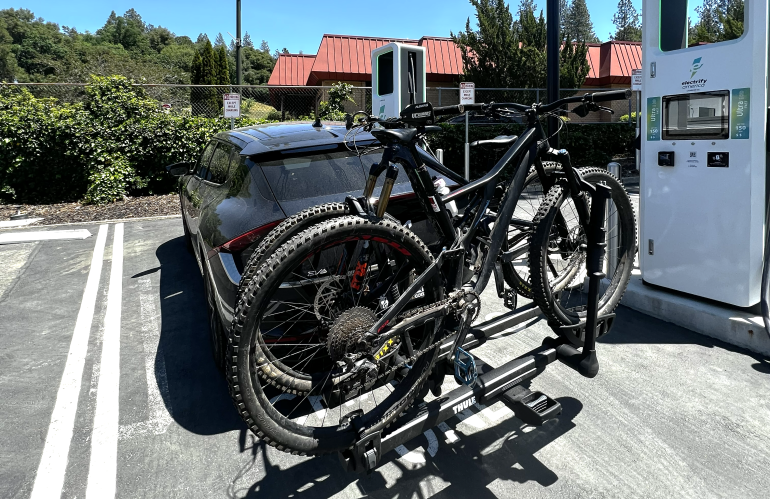
My biggest concern these days when I take my electric vehicle (EV) on a road trip is: will I have enough time to go to the bathroom?
Then vs. Now, at a Glance
My Family’s EV Story
My work and my family draw me all over the massive state of California, from one end to the other, roughly 800 miles top to bottom. My husband and I share a 2022 Kia EV6. Before that, we went carless for a few years during the pandemic. Before that, we drove a Chevy Bolt. We also have a used electric bike to get around, plus a garage full of regular, people-powered bikes. When we’re both staying local, I prefer the bike, since it lets me whiz past traffic and skip the hunt for parking, while my husband prefers the EV. It works out.
We were early adopters of EVs, and I think we’re unusual in how much long-distance EV travel we do. We live in Santa Cruz, have a niece in Humboldt, extended family scattered across Southern California, one kid who went to UCLA and another who went to UC San Diego, and we spend a lot of time in the Sierra. We get around, and we do it in an EV.
Driving an EV long distances was once hard to plan, and often disastrous. Chargers were sparse and geographically scattered, and they frequently didn’t work, were vandalized, or had twenty cars lined up waiting. Charging took at least an hour, often longer with a line, and doing that three or four times per trip because of limited range ate up the whole day. But today, owning an EV is, without a doubt, cheaper and more convenient than owning a gas-powered car. It just took a while to get there.
These days, the honest answer to “do I have time for a bathroom break” is often no. The coffee and snack run happens after we unplug from the fast charger, since the car usually hits 80 percent in under fifteen minutes. Some charging stations have even started charging extra fees for lingering past 80 percent, to keep chargers available for everyone else. It’s a strategy that has paid off. These days, there are fast chargers pretty much everywhere we go.
If you’ve heard horror stories and assume owning an EV is still too hard or impractical, let me walk you through how my own EV journey evolved. Driving an EV in 2017 was hard. Driving one in 2026 means charging quickly and readily, with little to no range anxiety. The only reason you’ll still stop at a grim, old-school gas station is a desperate craving for Twizzlers. Mostly, you’ll plug in at home a few times a week, and the occasional road trip will feel surprisingly similar to driving a gas car. That said, a few bad charging experiences before the pandemic left me with a lingering case of range anxiety, so I understand the worry.
In 2018, I think I had the biggest tantrum of my adult life at a broken charger in the middle of the Central Valley. It was hot, windy, and I was exhausted after days of having to be “on” for work meetings and events. I just wanted to be home. I had about 20 miles left in the Bolt and about 150 miles still to go. The charger wouldn’t work, and it was the only one for roughly 100 miles in either direction. After stomping my feet, yelling, and maybe shedding a few tears, I called the number posted on the charger. Someone calmly asked for a few numbers, remotely reset the unit, and it started working again like magic. I felt ridiculous, climbed back in the car, and cranked the most calming playlist I had.
In 2019, we caravanned our daughter down to UCLA from Santa Cruz to start her school year. She drove her old Volvo; we took the Bolt. We had to carefully plan the route around available chargers, and each charge took upward of an hour, often with a line of cars waiting their turn. A drive that should have taken six hours took closer to twelve. We swore off long-distance EV travel entirely, until Kia developed charging technology fast enough to beat even Tesla. Around the same time, Electrify America installed roughly 2,000 DC fast chargers across the state, funded as part of Volkswagen’s settlement over its “Dieselgate” emissions scandal. Electrify America is still just a slice of the total charging network, though: individual charging stations statewide grew from about 1,500 in 2017 to more than 18,000 in 2026. If we run into a line at one station now, we just drive to another nearby. In 2017, that simply wasn’t an option.
We used to rely on an app called PlugShare to plot our routes and make sure chargers lined up with our range. I still open it sometimes, mostly to find fun places to stop, stretch, and explore. Old habits die hard. But these days, chargers show up right on Google Maps, so we just wait until we’re getting low and let Google find us one, exactly how people find gas stations in a gas-powered car. Range anxiety is largely a thing of the past now, and surveys back this up: it’s a fear held mostly by people who don’t drive EVs, or who are new to them.
Charging the Bolt at home used to take forever. We never installed an actual wall charger, whether because of the cost or because we never got around to it. We just plugged it into a regular wall outlet, and a full charge from empty took one to two days. Forget to plug in overnight, and you were stuck the next day. But it’s worth noting that you don’t need any fancy equipment to charge an EV at home. You can just plug it into the wall. Many people don’t know that. Now we have a real home charger that takes the EV6 from zero to 100 percent in three to four hours. Charging fully at home is perfectly fine for battery health. Fast chargers are the ones you want to stop at 80 percent to preserve battery lifespan; slow home charging can safely go all the way to full. We plug in at home once or twice a week, and it’s set up to charge automatically when electricity rates are cheapest. We also have solar panels that offset the extra energy use from charging the car. And, to be clear, we recognize this is a position of privilege.
| Then: 2017 EV Road Trip | Now: 2026 EV Road Trip | |
| EV | EV: Chevy Bolt | EV: Kia EV6  |
| Finding Chargers | Finding chargers: Plugshare, EVGO, chargepoint, other disparate charging apps | Finding Chargers: Google Maps |
| Max Charge Speed | 55 kW old bolt (new bolts can charge at 150 kW) | 235-260 kW |
| Time to charge | ~ 1 hour from 10-80% | ~18 minutes from 10-80% |
| Range | 238 miles | 319 miles |
The Money Side and Income Qualifying Incentives
An EV still costs more upfront than a comparable gas-powered car, although the prices are coming down (see Slate “the most affordable truck in America). Used EVs, however, are quickly become much more cost effective than gas powered vehicles. That is because used electric vehicles have depreciated much faster than gas cars due to fast-moving battery technology and an influx of off-lease inventory. You can buy a used EV for well under $25k.
Installing a home charger, and possibly solar panels to power it, adds to that upfront cost but also adds to the savings. But you don’t need all that cash on hand to make it happen. GoGreen Financing, run through the California State Treasurer’s Office, connects homeowners and businesses with a network of contractors and lenders to finance EV chargers and solar panel installations, and even helps buy down the interest rate. At savings of up to $1,400 a year compared with a gas-powered car, that adds up to roughly $14,000 over ten years just from driving electric. California also offers separate incentives for EV purchases for income-qualifying buyers. MyFirstEV offers Californians a point-of-sale incentive for buying or leasing a new or used zero-emission vehicle for the first time. Incentives are $3,500 for new vehicles and $1,750 for used vehicles, funded equally by the state and participating automakers. Pacific Gas and Electric and Southern California Edison offer $1,000 for pre-owned EVs and $1,000 for charger installation.
The Driving Clean Assistance Program (DCAP) provides incentives statewide in California to assist low-income and disadvantaged communities in purchasing clean air vehicles of up to $7500-$14,000 per vehicle. Local Air Districts and Community Choice Energy providers also have incentives. EVs for Everyone is a program offered by Ecology Action and a good summary of incentives in California are provided on their website.
Even when solar is not an option for renters, charging an EV is still worlds cheaper than gassing up. Home EV charging averages about 3–6 cents per mile. Gasoline is about 12-18 cents per mile. That’s roughly 60% less per mile for home charging than gasoline, or put another way, gas costs three to four times more per mile than home charging an EV.
The federal §30C tax credit (30%, up to $1,000) ended for equipment placed in service after June 30, 2026, so there’s no federal credit for a charger installed now — utility rebates and state programs (like CALeVIP) are what’s left, and they vary by utility territory. Check your local utility’s website and your State’s EV incentives (California). There are income-qualifying incentives for first-time EV buyers and even used EVs.
Another challenge arises for those in multi-family housing dwelling. How do you get chargers installed in your apartment complex?
California’s 2025 Green Building Standards Code (CALGreen), effective January 1, 2026, requires every assigned parking space at new multifamily developments to include a low-power Level 2 EV charging receptacle — a big jump from the old ~40% requirement. That only applies to buildings permitted after that date, though, so for existing buildings, the §1947.6 tenant request process remains the main route. There is a Civil Code Right to Charge law that applies to existing complexes. If you rent and have a parking space that’s part of your lease, California law generally requires your landlord to approve a written request to install a charger there. Only problem is: you just have to pay for it. Tenants relying on public DC fast charging pay roughly $0.35–$0.50/kWh versus $0.06–$0.15/kWh for home Level 2 charging, so even a slow shared 240V outlet at your spot can pay for itself quickly if daily fast-charging is your alternative. Costs can escalate, however the electrical panel is outdated at your complex. That can lead to dead-end negotiations with landlords. In that instance, the alternative is just to “trickle charge” into a normal wall socket or charge away from home, which is not exactly convenient.
What if you’re not low-income?
Yes, the federal EV tax credit was eliminated by the “One Big Beautiful Bill,” and the current administration is trying to undo the successful greenhouse gas reductions attributable to EVs in California, but it still hasn’t killed the electric ca. Another long-standing tax loophole still favors EVs: the Section 179 vehicle write-off. Businesses can deduct the cost of a vehicle over 6,000 pounds, since the tax code assumes a vehicle that heavy is a genuine work tool, something a farmer, landscaper, or contractor needs. But the rule applies to any business buying a vehicle over that weight threshold, regardless of what it’s actually used for. Historically, this quietly encouraged businesses to buy gas-guzzling trucks and SUVs they didn’t strictly need. Now, because EV batteries are heavy, several EVs land in that same weight class, and the same rule that once subsidized gas-guzzlers is now nudging businesses toward electric.
Some EVs that clear the 6,000-pound Gross Vehicle Weight Rating (GVWR) threshold:
- Tesla Model X — GVWR 6,250+ lbs, starting around $80,000
- Rivian R1S — GVWR 7,700+ lbs, starting around $76,000
- BMW iX — GVWR 6,173–6,613 lbs, starting around $85,000
- Ford F-150 Lightning — GVWR 6,500–8,250 lbs, starting around $55,000
- Chevrolet Silverado EV — GVWR 8,000+ lbs, starting around $57,000
- GMC Hummer EV SUV — GVWR 9,500+ lbs, starting around $85,000
Why I’d Still Say Go Electric
Looking back at that 2019 drive to UCLA, the twelve-hour slog that should have taken six, I sometimes can’t believe it’s the same activity as the trips we take now. The technology got faster, the charging network got denser, and the range anxiety that once ruled our travel decisions has all but disappeared. What used to require military-grade trip planning now looks almost exactly like driving a gas car: you go until you’re low, you find a charger nearby, and you’re back on the road in less time than it takes to grab a snack.
The financial case has shifted since the federal tax credit disappeared, but it hasn’t gone away. Between the money you save every year on fuel and maintenance, the financing programs that lower the upfront cost of a home charger and solar setup, the income-qualifying incentives in California and the write-off still available to businesses buying heavier EVs, owning one is still the cheaper choice over the life of the car, not just the greener one. And that’s before you factor in the quieter ride, the instant torque, or the simple relief of never smelling like a gas station again.
If you’re on the fence because of what EV ownership used to be like, or because of some story you heard from a friend who tried it back when the charging network was thin, I get it. I lived that version. But that version is gone. The cars are faster and go further, the chargers are everywhere in California, and the case for switching has never been stronger. You don’t have to be an early adopter to enjoy the ride anymore. You just have to plug in.